
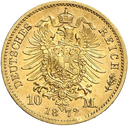


10 Mark King Johann Saxony Gold Coin
Berlin Mint
The Berlin Mint is a German mint located in Berlin.
It produces circulation, commemorative, and collector coins for Germany.
Coins from Berlin bear the mint mark “A.”
The mint combines long-standing tradition with modern minting technology.
GPSR: Münze Deutschland
Barbarastr. 1
50735 Köln
(0961) / 3818 3970
info@muenze-deutschland.de
🇩🇪 10 Mark Saxony 1872–1873 – Gold Coin King Johann – Early Imperial Issue in Calm Dignity
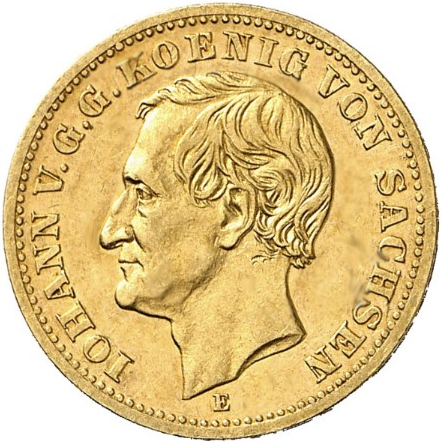
The 10-mark gold coin of the Kingdom of Saxony bearing the portrait of King Johann of Saxony is among the early gold issues of the German Empire. It was minted in the years 1872 and 1873, immediately after the founding of the Empire, during a phase of political reorganization and state consolidation. Struck in gold, this coin combines Saxon independence with the new imperial structure and presents a design characterized by calmness, clarity, and sober monarchic dignity.
The obverse shows the portrait of King Johann facing right, rendered in a finely modeled, restrained depiction. The linework is clear and calm, without exaggeration or staging. The face appears composed and dignified, with an expression conveying experience and state responsibility. Surrounding the portrait is the inscription “JOHANN KOENIG VON SACHSEN,” evenly arranged and clearly legible. Beneath the portrait appears the mint mark “E,” representing the Muldenhütten Mint, discreetly embedded into the field. The gold surface around the effigy remains open and calm, allowing the portrait to appear clearly.
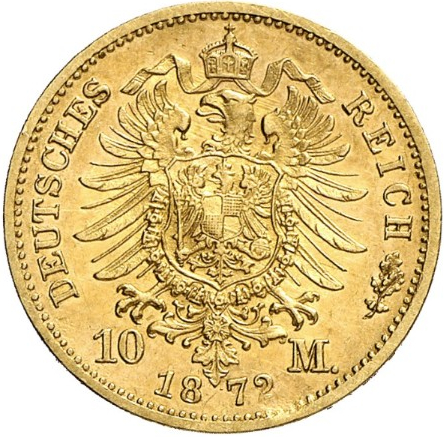
The reverse depicts the crowned imperial eagle, the sovereign emblem of the German Empire, executed in a sober and clearly defined form. The eagle stands calmly at the center of the field, without dramatic spread or exaggerated symbolism. Above it is the denomination “10 MARK,” below it the respective minting year. An encircling oak-leaf wreath, whose finely worked leaves are highlighted in bold as a central motif detail, frames the depiction. The oak leaves appear organic and evenly arranged, lending the reverse structure and balance.
The coin is struck in 900 gold, a period-typical alloy that gives the surface a warm, bright tonality. The relief is precisely executed, yet without harsh contrasts. Light and shadow arise softly and in flowing transitions. The reeded edge complements the design with a classic tactile element reflecting the minting artistry of the 19th century.
King Johann reigned over Saxony from 1854 to 1873 and was regarded as an educated, politically prudent monarch. His coin portraits avoid pathos and instead rely on clear contours and calm order. This approach is clearly reflected in the 10-mark gold coin.
The 10 Mark King Johann of Saxony gold coin thus remains an early testament to Saxon minting art within the German Empire. It unites monarchic portraiture, state symbolism, and the quiet presence of gold into a coin image that convinces through calmness, clarity, and historical dignity.
| Metal | Gold |
| Form | Gold Coin |
| Country of Origin | Germany |
| Manufacturer | Berlin Mint |
| Series | German Empire |
| Purity | 900/1000 |
| Fineweight | 3.58 gram |
| Gross Weight | 3.982 gram |
| Grade | Brilliant |
| Condition | Circulated |
| Face value | 10 Mark |
| Thickness | 0.91 mm |
| Diameter | 19.50 mm |
| Packaging | Single in Pouch |