
Part 2 of 3: Foundational protection and risk management.
Important note: This article is for general information purposes only and does not constitute investment, legal, or tax advice. All figures, returns, and sample calculations mentioned are based on historical data and simplified, hypothetical scenarios — past performance is not a reliable indicator of future results. Trading in stocks, precious metals, CFDs, cryptocurrencies, and other asset classes mentioned here carries risks, up to and including total loss of the capital invested. CelticGold AG assumes no liability for decisions made on the basis of this article. Please seek independent advice from a licensed financial, legal, or tax advisor before making any investment decision.
In Part 1 we worked through the mechanics of interest and compound interest and defined the benchmark: a 15% annual return is what the professionals themselves reach for. Before we talk about the strategies that can actually get you there in Part 3, we need to talk about the foundation. Without a foundation, any discussion of returns is purely academic — because a single bad month without protection can tear away more of your wealth than ten good years can rebuild.
The wealth pyramid
In advisory conversations, we used to almost always work with a wealth pyramid to visualize the principle. It still works today, because it shows a simple truth: what stands broad and stable at the bottom carries everything that comes above it.
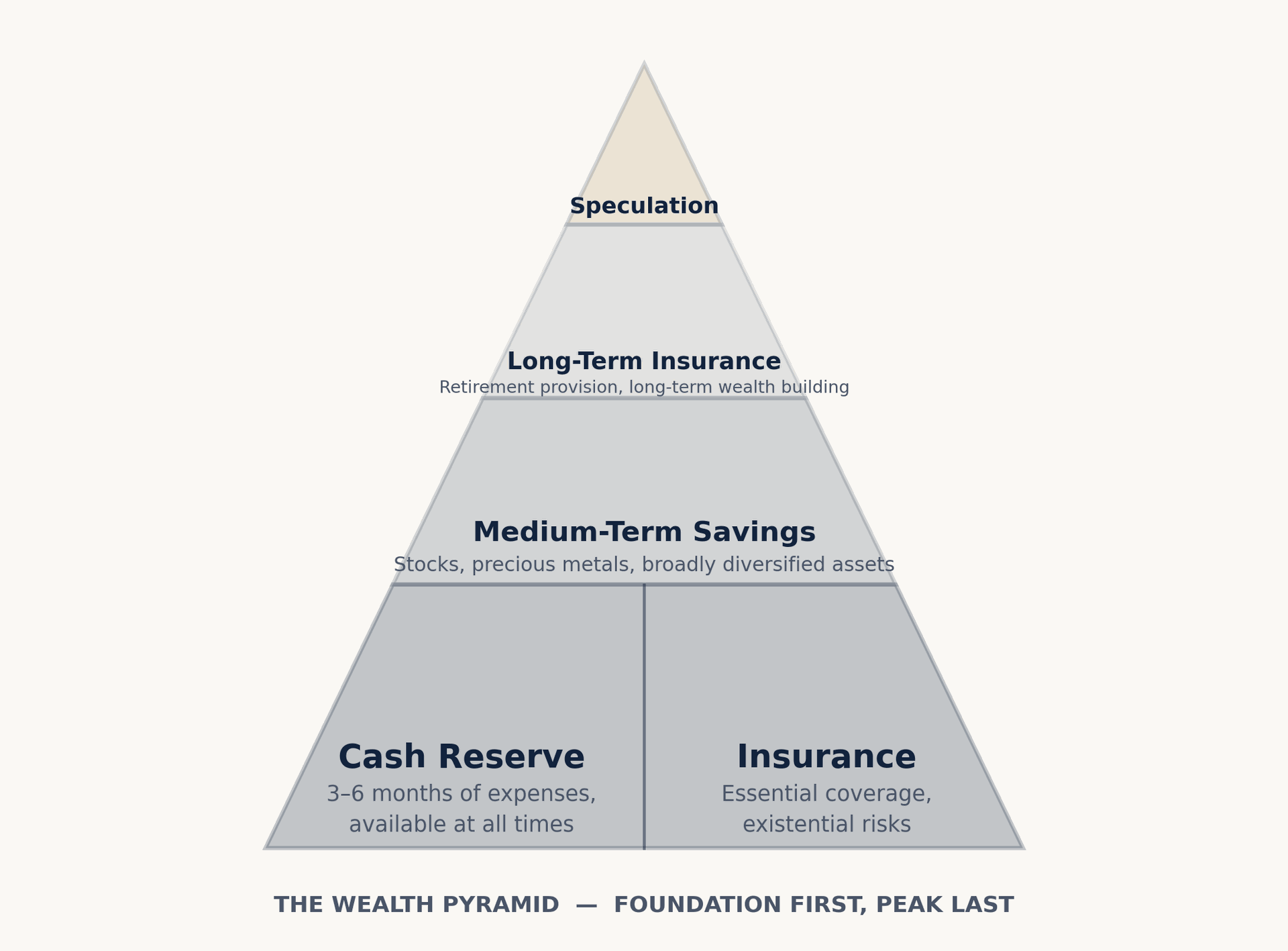
- Base (broad, two parts): insurance against existential risks on one side, cash reserve on the other.
- Middle: medium-term savings — stocks, precious metals, broadly diversified investments.
- Top: long-term insurance and long-term wealth building.
- Peak: speculation — the smallest part, right at the top, last.
The order is no accident. Whoever starts at the peak is building on sand.
The "solid" middle of the wealth pyramid
The cash reserve: security you can feel
Let's start at the bottom, with the foundation. The cash reserve has an unbelievably important emotional and psychological component. It's indispensable and should amount to 3 to 6 months of your living expenses — and it must be available and accessible at all times, without notice periods, without price risk, no ifs, ands, or buts.
Why is this so important? In conversations with younger people, 20 to 25 years old, I notice: for many, the cash reserve isn't a focus — and yet it's more important than ever. Those among the younger generation who have mastered this challenge consistently report sleeping soundly, an inner sense of security, and a feeling of independence and freedom.
And that's exactly what the cash reserve does for you: no matter what happens, you're safe. Lost your job? No problem. Car broken down? No problem, at least for the next 3 to 6 months — enough time to find alternatives.
In a world where almost anything can be delivered to your door with a few swipes, subscriptions, monthly payments, and these constant financial obligations are not helpful from a psychological standpoint. The cash reserve reverses that. That doesn't mean subscriptions are inherently bad — but taking a close look at what you really need and what you don't helps enormously. And ruthlessly cancelling the subscriptions you don't use helps increase your monthly savings rate.
Two tips for well-founded purchasing decisions
- The three-day rule. If you put products in your cart because you absolutely need them right now: wait three days to a week, then look at your cart again. If you still need it — buy it. In roughly 70% of cases, you no longer need it.
- Think in years, not days. Work out what a purchase actually costs over one year, two years, and three years. Suppose you're considering a subscription that costs 90 € a month — or, as it's often marketed, "just 3 € a day." That's 1,080 € a year. What else could you do with that 1,080 €? A holiday? Pay down a loan? This exact counter-calculation is missing from most purchasing decisions.
Consumer debt: it all has to go
Now that we've finished the cash reserve discussion, a brief but important detour into loans, consumer debt, and installment payments. In short: it all has to go.
Let's work out what an impulse purchase actually costs. Take a new corner sofa for 2,000 €, financed at 18% interest p.a., with a monthly installment of 50 €.
18% per year is 1.5% per month. In the first month, that's 30 € in interest on 2,000 €. Of your 50 € installment, only 20 € actually goes toward paying down the principal — the rest disappears into interest before any of the outstanding balance is even reduced.
Work it all the way through, and you're debt-free after 62 months — a good 5 years. In total, you will have paid 3,077 €. For a sofa that cost 2,000 €, you paid 1,077 € in interest alone — more than half of the original purchase price, just so you didn't have to pay for the sofa in cash right away.
Never again consumer debt. And if you currently have debt: pay it off as quickly as possible. Every euro that goes into consumer-debt interest is a euro that isn't working for you — it's working for the bank.
Back to the pyramid: why standard products don't get you to the 15% benchmark
The base is set. Now let's look upward, at the middle and upper part of the pyramid — where the investments touted by the financial industry sit. Marketing prose and industry misinformation don't help us here in reaching the 15% a year we talked about in Part 1. That brings us to the actual core topic of Part 2: risk in investing — and the psychology of wanting to get rich quick.
The mathematics of loss
First, a calculation everyone should understand before investing a single euro: suppose you lose 50% of 10,000 €. What percentage gain do you need just to get back to the starting value?
The answer is not 50%. It's 100%.
| Loss | Gain needed to recover |
|---|---|
| −10% | +11.1% |
| −25% | +33.3% |
| −50% | +100% |
| −75% | +300% |
| −90% | +900% |
The reason: after a loss, the base on which the required gain is calculated has shrunk. From 10,000 €, a −50% loss leaves only 5,000 € — and 5,000 € has to double to get back to 10,000 €. That's pure math. And it's the most important reason why we want to eliminate risk as much as possible before we even talk about returns.
Quick money, leveraged products, and margin calls
Today's problem: everyone wants to make fast money. The "chase" for the breakthrough, the one big hit, is more interesting to many people than targeted, informed investing — for whatever reason.
Two examples you hear constantly in this space:
"If only I'd bought Bitcoin at 10 cents..." — Bitcoin's historical low was around 5 US cents in July 2010. At a current price of around 65,000 US dollars (as of August 2026, highly volatile), that corresponds to a gain of more than 1,000,000 times. Impressive — in hindsight. But: whoever actually invested in Bitcoin in 2010 had no way of knowing whether it would turn into a success story or a total loss by 2026. There were several periods in between with drawdowns of over 80%.
An example of leverage mechanics with CFDs: at a leverage of 100:1, a margin of 1,000 € corresponds to a market exposure of 100,000 €. If the market moves just 1% against your position, you lose 1,000 € — your entire margin. A single percentage move is enough at this leverage to wipe out the position completely. The higher the leverage, the smaller the price move needed for a total loss — 10% at 10:1, just 1% at 100:1, and a mere 0.2% at 500:1.
If you are not a professionally trained trader, then it is not for you, more than 80% of investors loose money with these financial instruments.
Often it's precisely this chase and speculation in highly speculative areas — alongside one's own psychology — that pushes success off into "the next life."
What you actually want
What you want is as much return as possible with as little risk as possible. That is the real definition of good investing — not the next big hit.
Ray Dalio, founder of Bridgewater Associates, has provided one of the most influential formulas in modern portfolio theory on this point. He calls it his "Holy Grail of Investing": if you find 15 to 20 good, mutually uncorrelated investments and balance your risk, you can reduce your risk by up to 80% — without sacrificing return. And that's exactly where we want to go.
What does "correlated" mean?
Two examples make this tangible:
- Correlated: Coca-Cola and PepsiCo. Both companies are in the same business, with the same customers, the same input costs, the same consumer behavior, and the same economic environment. If one stock does poorly, the other usually does too. Anyone holding both believes they are diversified — but hardly is.
- Uncorrelated (or weakly correlated): gold and the S&P 500. In times of crisis, when stocks fall, capital often seeks refuge in gold — the two then move in opposite directions, or at least independently of each other. It's precisely this property that makes a combination of the two far more resilient than a pure stock position.
Gold/silver as an uncorrelated portfolio building block
Back to Part 1: why "buy and hold" alone isn't enough
In Part 1 we established: a 15% annual return is the benchmark. Let's now look at two well-known "buy and hold" strategies:
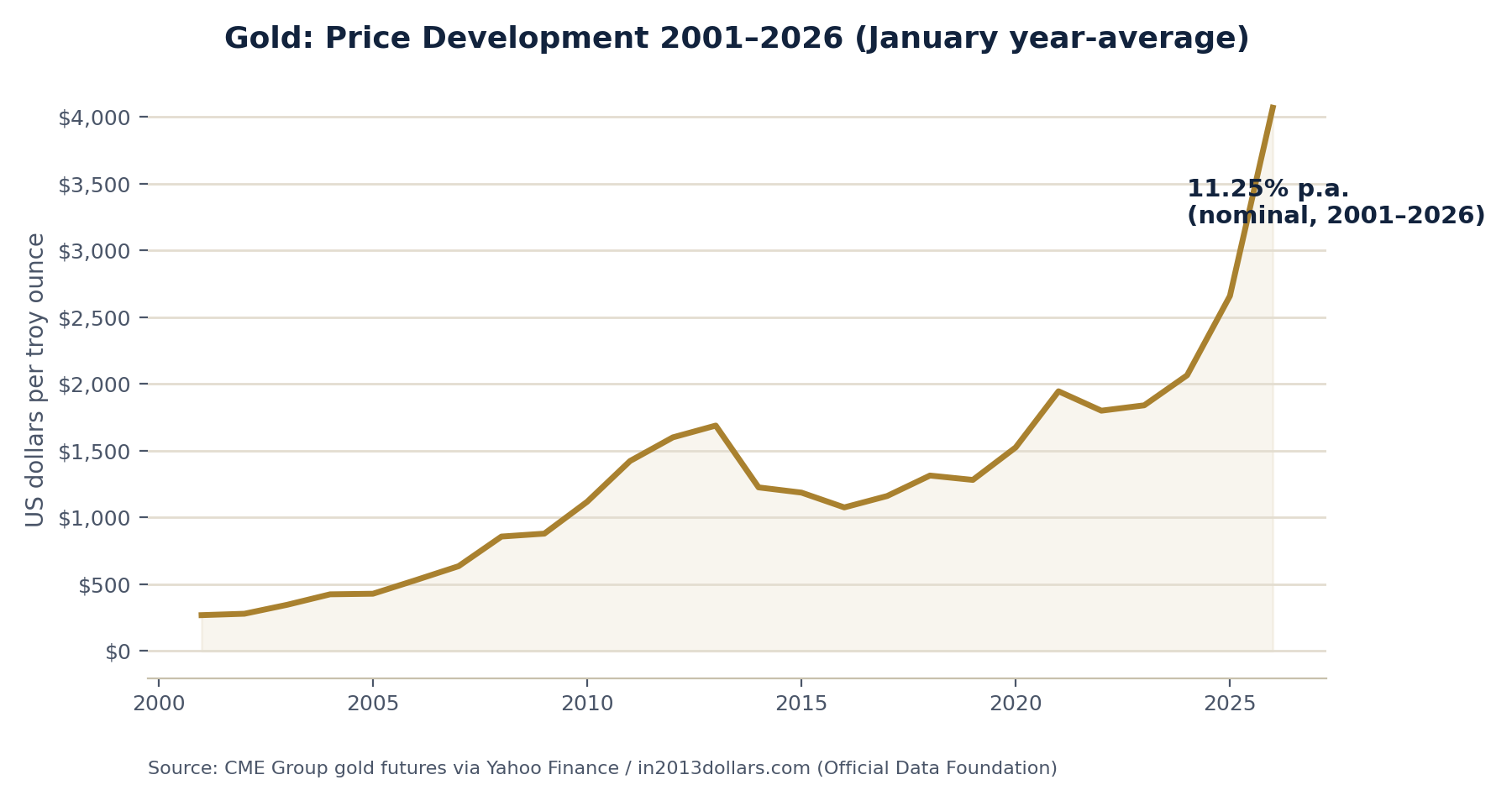
1) Gold - buy and hold for 25 years
2) S&P 500 - buy and hold for 25 years
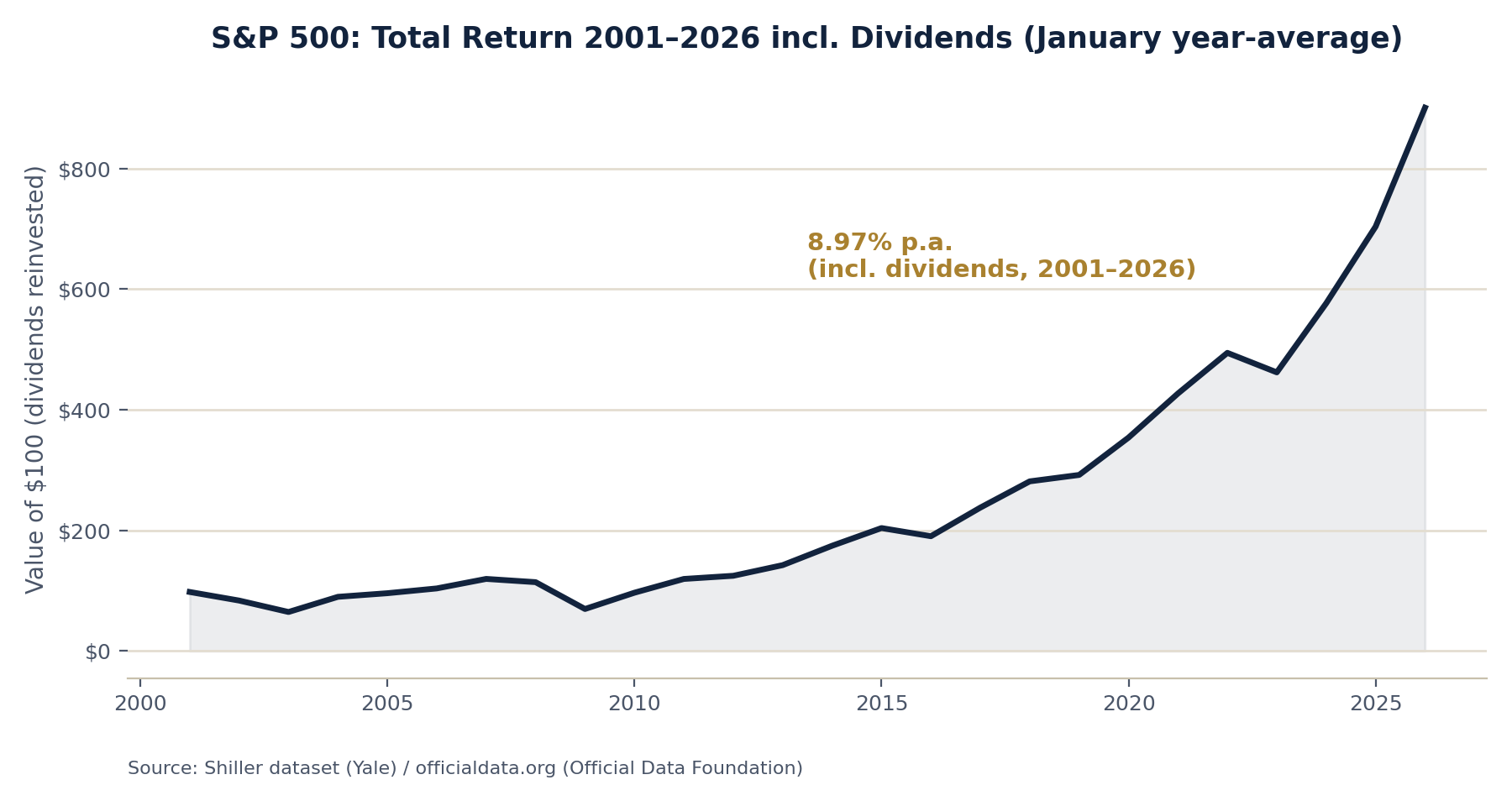
But even the two "safest," most commonly recommended buy-and-hold investments of the past 25 years didn't reach the 15% annual mark on their own.
| Investment (last 25 years, since 2001) | Annualized return |
|---|---|
| Gold | ≈ 11.25% p.a. (nominal, not inflation-adjusted) |
| S&P 500 (incl. reinvested dividends) | ≈ 8.97% p.a. |
Both figures are good, solid, historically documented results — far better than the 2% or 4% offered by the industry, and a good way to shift the equation in our favor — but both still fall noticeably short of the 15% benchmark from Part 1. Gold alone wouldn't have gotten there. The S&P 500 alone wouldn't have gotten there either. So we need more than "buy one investment and let it sit" — we need strategies that can actually close the gap to the 15% mark. That's exactly what Part 3 is about.
Frequently asked questions about cash reserves and risk management
How large should a cash reserve be? As a rule of thumb, 3 to 6 months of expenses, available at all times and without price risk — so not invested in stocks, funds, or cryptocurrencies, but held in an instant-access account or as cash.
Why is a loss harder to recover from than it was to incur? Because the base on which the calculation is made shrinks after a loss. A 50% loss requires a subsequent gain of 100% to return to the starting value — not 50%. The larger the loss, the more disproportionate the gain needed to recover.
What is Ray Dalio's "Holy Grail of Investing"? Ray Dalio, founder of Bridgewater Associates, uses this to describe the principle of combining 15 to 20 good, mutually uncorrelated investments and balancing their risk. According to Dalio, this can reduce portfolio risk by up to 80% without having to sacrifice return.
Is "buy and hold" enough to achieve a 15% return? Generally not. Both gold and the S&P 500 achieved around 9–11% p.a. on their own over the past 25 years — solid, but below the 15% benchmark. Getting closer requires additional strategies, which are covered in Part 3 of this series.
Summary and conclusion
- Basic protection and a cash reserve are mandatory. Without a foundation, any discussion of returns is worthless — an unprotected setback destroys more than good years can rebuild.
- Chasing the quick hit usually only makes one person rich — the one who created the product. Highly leveraged, high-risk products such as CFDs, crypto token issuances, or the thousandth new "shitcoin" don't help us reach the 15% mark. Usually they achieve the opposite.
- "Buy and forget" delivers solid but insufficient results. Stocks and precious metals each deliver around 9–11% per year on their own over 25 years. Impressive compared to a savings account — but not yet the benchmark.
- Eliminate risk wherever possible. Every significant loss requires a disproportionate amount of time and return just to get back to the starting point. That's exactly why risk management isn't a side issue — it's the actual art of investing.
How these building blocks — safety, low correlation, controlled risk — are actually assembled into a strategy that approaches the 15% mark: that's the topic of Part 3.
This article is part of a three-part series and does not constitute investment, legal, or tax advice. All sample calculations are simplified, historically documented scenarios and are not a promise of future returns.