


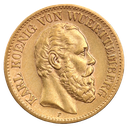
5 Mark King Ludwig II. Bavaria Gold Coin | 1877-1878

Münzprägestätten Deutschland
Germany has five active coin mints responsible for producing circulation and collector coins. Each mint is identified by a specific letter on the coin:
A – Berlin
D – Munich
F – Stuttgart
G – Karlsruhe
J – Hamburg
These letters indicate where the coin was minted. The German Bundesbank distributes the minting quotas evenly among these locations. In addition to euro coins, the mints also produce commemorative and special edition coins.
GPSR: Münze Deutschland
Barbarastr. 1
50735 Köln
Germany
+49 961 / 3818 3970
info@muenze-deutschland.de
🇩🇪 5 Mark King Ludwig II of Bavaria 1877–1878 – gold coin – Royal portrait in southern German imperial coinage
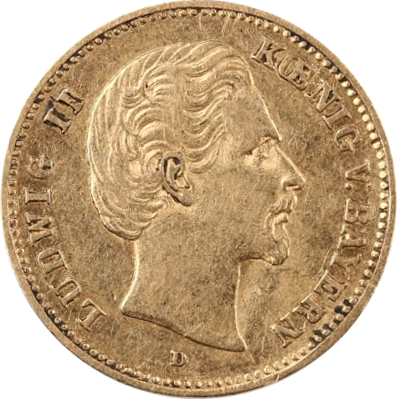
The 5 Mark gold coin of the Kingdom of Bavaria from the years 1877–1878 reflects the connection between regional monarchy and the overarching structure of the German Empire. It was minted at the Munich Mint with the mint mark “D”, clearly identifying its origin. The design follows the standardized specifications of imperial gold coinage, while incorporating a distinctive depiction of the Bavarian king.
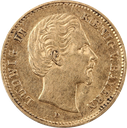
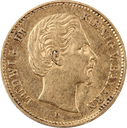
The obverse shows the right-facing portrait of King Ludwig II of Bavaria. The depiction is calm and clearly executed, with finely modeled facial features and an even line structure. The hair and contours are precisely rendered, giving the portrait a balanced sense of depth. Surrounding it is the inscription “LUDWIG II KOENIG V. BAYERN”, framing the image and clearly stating the monarch’s title.
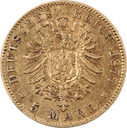
The reverse features the imperial eagle of the German Empire with outstretched wings. Above the eagle is the imperial crown, while on its chest appears a shield bearing the Prussian eagle. Encircling the design are the inscriptions “DEUTSCHES REICH”, the denomination 5 MARK, and the respective year. The composition is clear and symmetrical, following the typical design principles of imperial coinage.
The minting quality is fine and precise. The details of the royal portrait as well as the structure of the eagle are cleanly modeled and clearly separated. Light moves calmly across the surface and subtly highlights the individual design elements. The combination of smooth areas and fine structures creates a balanced three-dimensional effect.
The coin consists of a gold alloy with a fineness of 900/1000 and has a total weight of approximately 1.99 grams, corresponding to a fine gold content of about 1.79 grams. With a diameter of around 17 millimeters, the coin presents a compact and well-balanced appearance, reflecting its function as a circulation gold coin.
The design combines the personal depiction of the Bavarian king with the state symbolism of the Empire. While the obverse places the portrait of Ludwig II at the center, the reverse complements the design with the imperial eagle, adding its political context. The clear line work creates a calm and cohesive overall impression.
In its entirety, the 5 Mark gold coin Bavaria 1877–1878 represents a precise and balanced example of early imperial coinage, characterized by clear form, restrained visual language, and historical significance.
| Metal | Gold |
| Form | Gold Coin |
| Country of Origin | Germany |
| Manufacturer | Münzprägestätten Deutschland |
| Series | Kaiserreich |
| Purity | 900/1000 |
| Fineweight | 1.79 gram |
| Gross Weight | 1.99 gram |
| Year of issue | 1877 - 1878 |
| Grade | Brilliant |
| Condition | Circulated |
| Face value | 5 Mark |
| Thickness | 0.6 mm |
| Diameter | 17.00 mm |
| Packaging | Single in Pouch |