
Bitcoin hit a new all-time high of USD 112,000 on 22nd May 2025, but then entered a seven-week consolidation phase. Contrary to expectations of a direct rally continuation in mid-June, prices briefly pulled back to USD 98,240 before rebounding above the key psychological level of USD 100,000.
1. Review
The bulls ultimately prevailed after consolidation, with Bitcoin breaking out above the broad USD 110,000 resistance zone on 10th July. Prices then surged rapidly to a new all-time high of USD 123,236, triggering significant profit-taking and a quick drop of about USD 7,500—or 6%—leaving the price stabilising just below USD 120,000 in recent days. Recent gains come as no surprise given rising institutional buying interest; the jump from USD 110,000 to USD 123,236 was driven primarily by over USD 2.5 billion in inflows to spot BTC ETFs and more than USD 1 billion in short liquidations on crypto derivatives. Institutional investments—especially via ETFs like BlackRock's IBIT with USD 80 billion in assets, plus Bitcoin treasury firms like MicroStrategy buying through debt and equity raises—amplify this rise through a self-reinforcing cycle of ETF inflows, liquidations, and corporate purchases, though it also carries the risk of a sudden reversal.
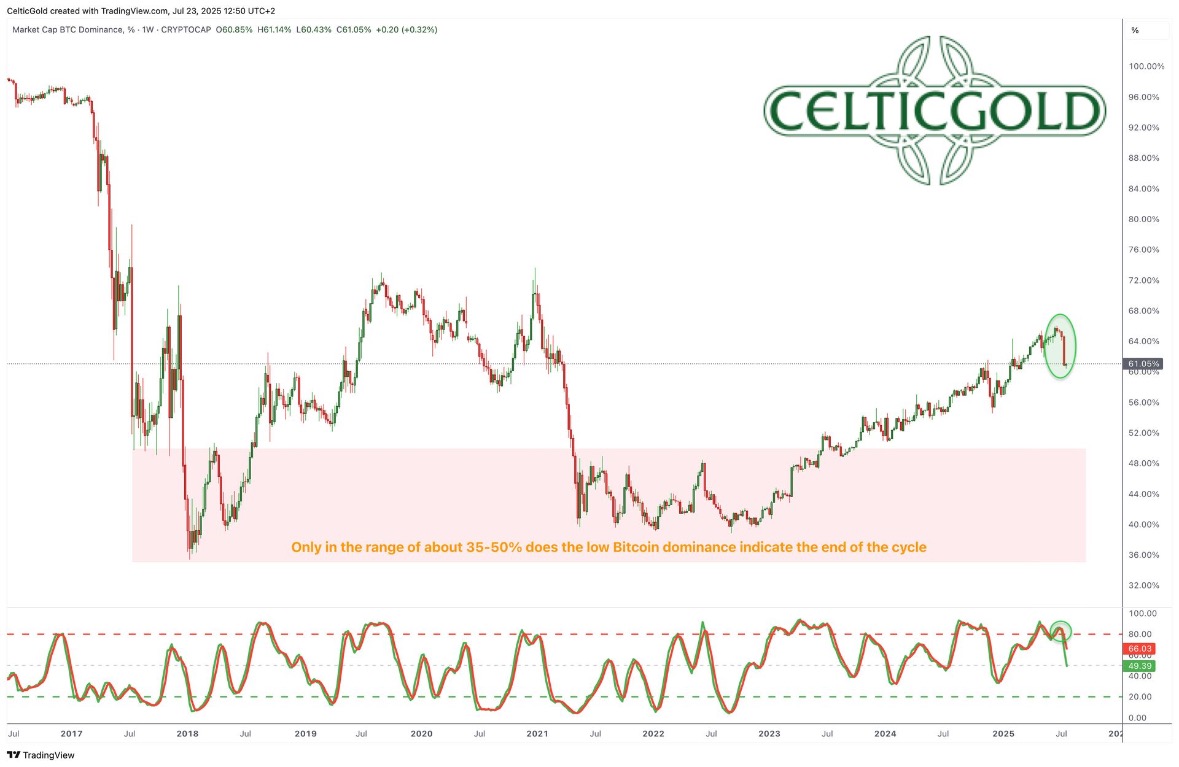
Bitcoin Dominance in Percent, Weekly Chart as of July 23rd, 2025. Source: Tradingview
While Bitcoin has stagnated and consolidated for the past 10 days, capital is flowing into alternative cryptocurrencies and new crypto IPOs. Bitcoin dominance has clearly dropped from about 66% to currently 61% in recent days, signaling inflows into altcoins. Projects like Solana, Ethereum, XRP, and Dogecoin have posted strong price gains lately, underscoring growing investor risk appetite. While innovations and hype drive altcoin prices higher, many coins still have significant catch-up potential. At the same time, the cycle may be nearing its end, as an altcoin rally typically concludes the broader uptrend. The question remains whether the entire four-year crypto cycle is ending or if the coming weeks will merely see an important interim high.
2. Bitcoin Chart Analysis in USD
2.1 Weekly Chart: Price Target Still Around USD 125,000–130,000
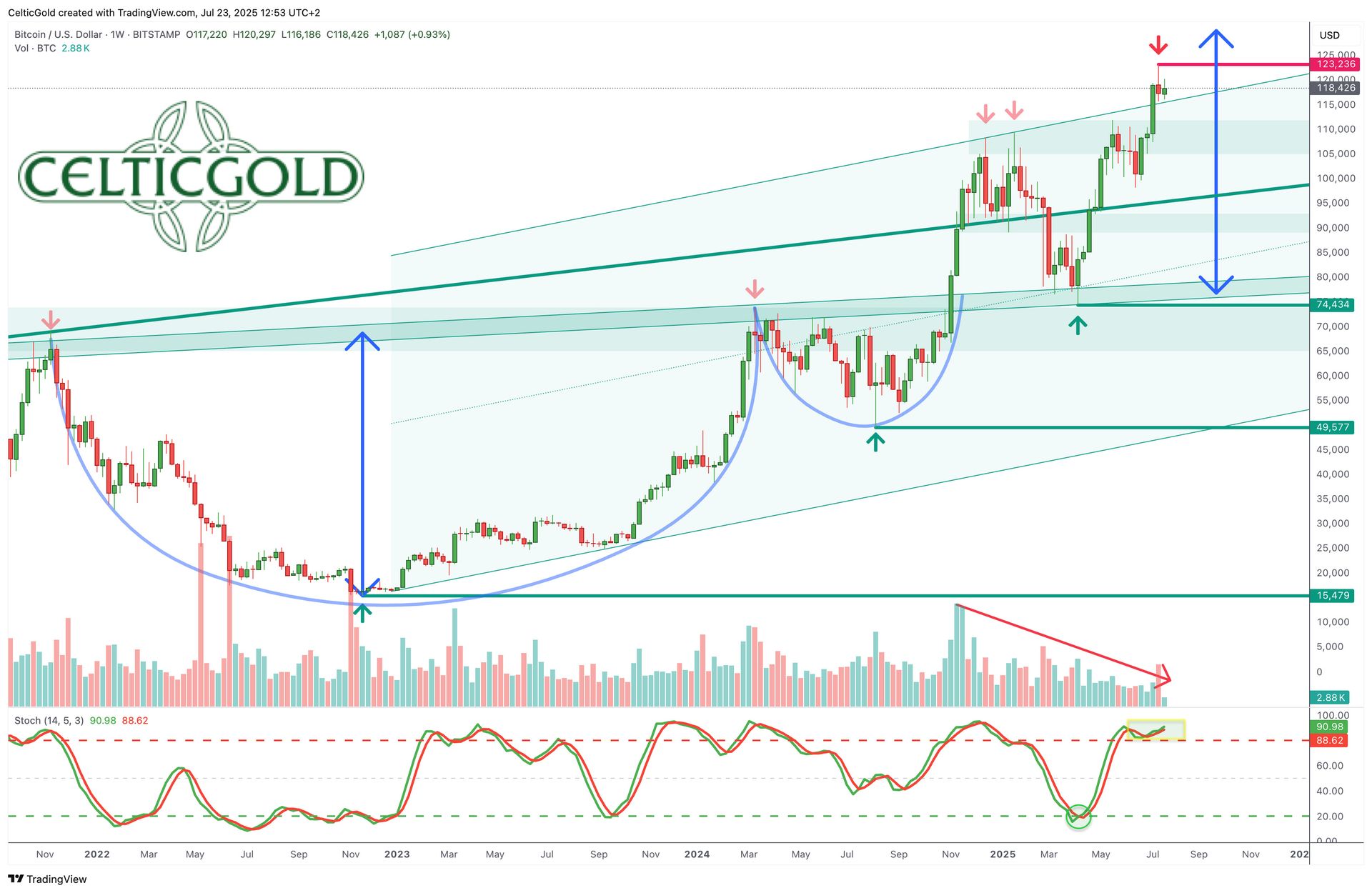
Bitcoin in USD, Weekly Chart as of July 23rd, 2025. Source: Tradingview
After breaking out to a new all-time high of USD 123,236 (14th July 2025), the Bitcoin weekly chart—currently around USD 118,400—shows robust bullish momentum. The quick pullback to USD 115,750 on 15th June represents no technical damage in the broader weekly timeframe and counts as normal market noise, supported by the solid base between USD 110,000 and USD 112,000. Weekly stochastic remains bullishly embedded in overbought territory (>80), reinforcing the uptrend's strength and locking it in for now. The %K line runs clearly above the %D line with no signs of a bearish crossover—a classic sign of bullish embedding. Trading volume, however, has trended lower since the start of the year.
Holding firmly above the psychological USD 100,000 mark and breaking to new all-time highs in early summer strengthens the bullish structure. With the uptrend intact, Bitcoin remains on track for our second price target from its large cup-and-handle formation, in the USD 125,000–130,000 range. Overall, the weekly chart is bullish and points to a continuation toward USD 125,000–130,000. Only a sustained drop below the former USD 110,000 resistance zone would currently challenge this optimistic outlook.
2.2 Daily Chart: High-Level Consolidation as a Springboard
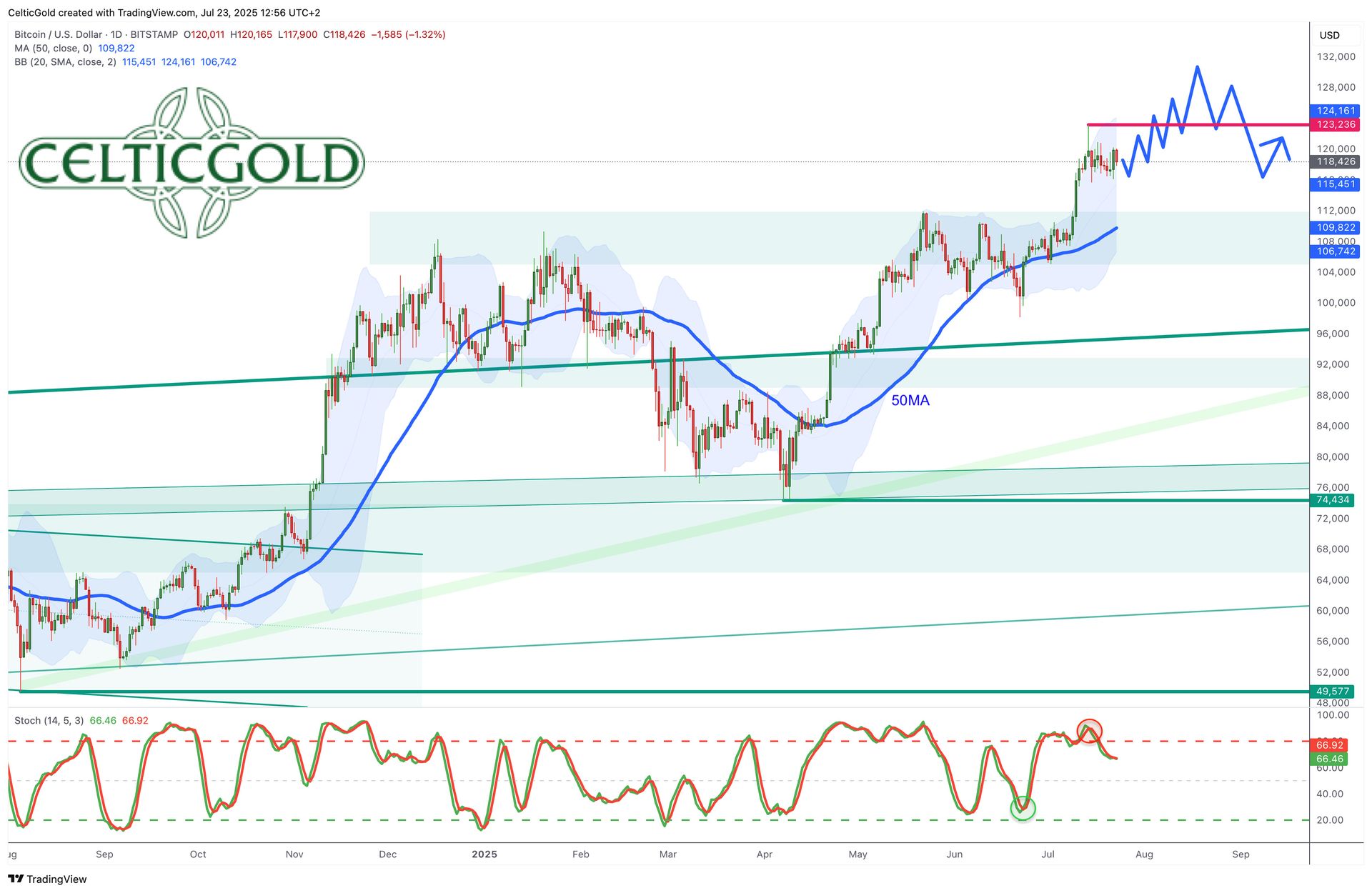
Bitcoin in USD, Daily Chart as of July 23rd, 2025. Source: Tradingview
The daily chart has taken a hit from the quick pullback off the new all-time high, activating a stochastic sell signal that has yet to play out negatively amid the established uptrend. Bitcoin prices are instead consolidating the steep rise at elevated levels. Distance to the 50-day line (USD 109,822) is not yet dramatic, while the upper Bollinger Band allows room up to about USD 124,000. Ideally, Bitcoin soon ends this minor high-level consolidation and resumes climbing toward USD 125,000–130,000.
A drop below USD 115,000 would likely lead back to the former USD 110,000 resistance zone. In that case, caution is warranted given the looming summer lull in equity markets until mid-October. Overall, the daily chart is neutral, as stochastic must clearly turn upward again. No major trend change or deeper pullback is evident yet. Odds strongly favour a near-term rally resumption.
3. Bitcoin Sentiment – Too Optimistic Again?

Crypto Fear & Greed Index as of July 23rd, 2025. Source: Bitcoin Magazine Pro.
The "Crypto Fear & Greed Index" currently stands at 74 out of 100 points, signaling clear optimism in the crypto market. Over the past two and a half years, true fear phases were rare: notable uncertainty only emerged in early August 2024 and briefly in late March/early April 2025. Market sentiment remained mostly confident over long stretches. This persistent baseline confidence may be dampening Bitcoin's price momentum compared to prior cycles. While sentiment is not yet overheated, it feels somewhat too optimistic and could explain restraint on bigger price surges.
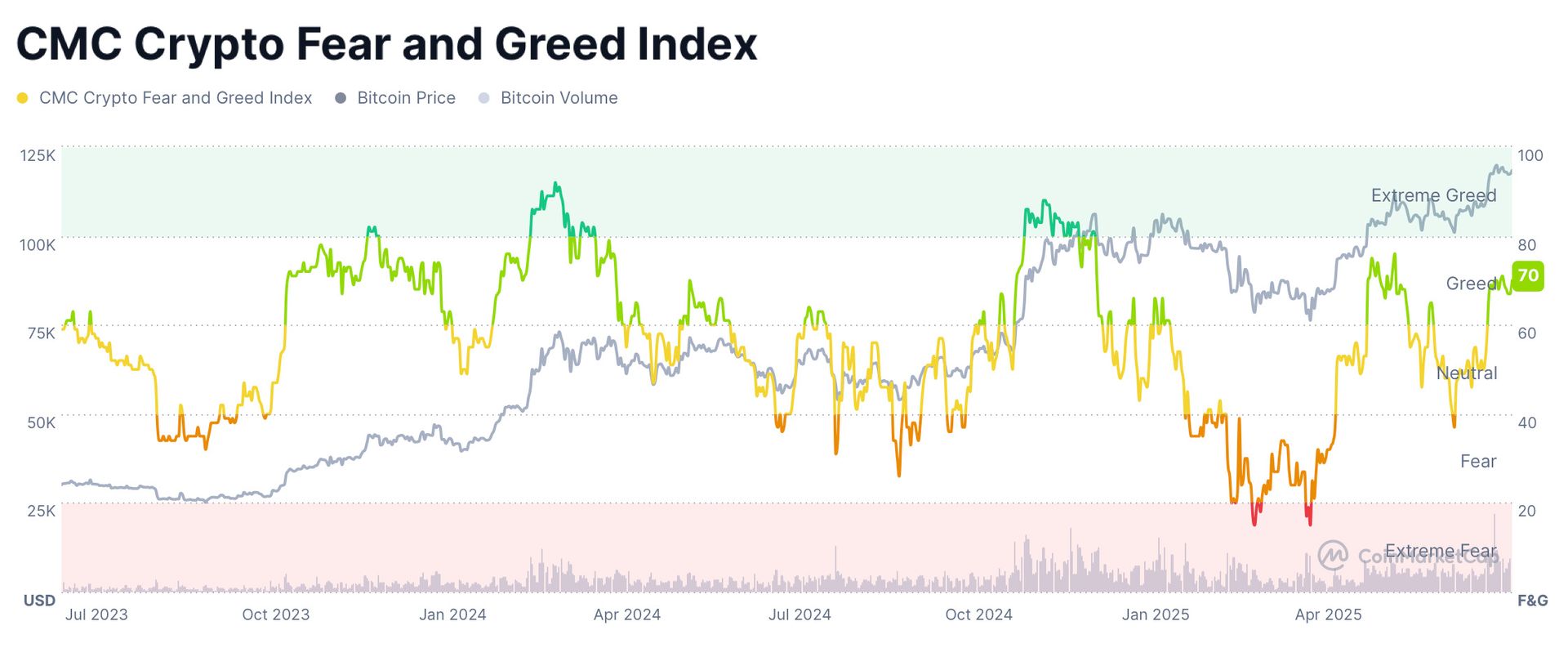
CMC Crypto Fear & Greed Index as of July 23rd, 2025. Source: Coinmarketcap.
CoinMarketCap's "CMC Crypto Fear & Greed Index" also reports mildly elevated optimism. In sum, sentiment seems headed back toward excessive euphoria. There's still some room before a clear extreme.
4. Bitcoin Seasonality – Extremely Positive Until Mid-June

Bitcoin Seasonality as of July 23rd, 2025. Source: Seasonax
Though this year's Bitcoin rally kicked off on schedule in early April, the seven-week consolidation from late May to early July—along with the July all-time high—deviated from familiar seasonal patterns. Statistical patterns over the past 15 years suggested a peak already in June, so the current path diverges from history. Perhaps the typical pattern simply shifted by a few weeks this year, with the July 11 high arriving belatedly. By classic seasonality, the peak would then be in, and Bitcoin prices would be drifting toward the common September/October low. Yet this assumption doesn't fully fit the ongoing bullish market action. Still, seasonality urges caution over the next two and a half months.
In summary, the seasonal light stays red until late September/early October. The next one to four weeks may belatedly deliver the classic Bitcoin summer top.
5. Bitcoin vs. Gold (Bitcoin/Gold Ratio)

Bitcoin/Gold Ratio, Daily Chart as of July 23rd, 2025. Source: Tradingview
At around USD 118,500 per Bitcoin and USD 3,420 per fine ounce of gold, one Bitcoin currently costs about 34.7 ounces of gold. Conversely, one ounce of gold costs about 0.0288 Bitcoin. Since the last trend reversal on April 11, Bitcoin has clearly outperformed gold by around +47% at its peak. From a low near 25, the Bitcoin/gold ratio rose sharply to nearly 37. While gold consolidated sideways at high levels, Bitcoin's strong price rise drove the outperformance. The ratio is now testing the strong resistance zone of 37–41.
Short-term, a stochastic sell signal has crept into the daily chart. Gold could thus regain some ground. Once Bitcoin's consolidation ends and the rally resumes, however, the ratio should target around 40. Overall, the Bitcoin/gold ratio confirms Bitcoin's current breather.
6. Macro Update – Paradigm Shift in the Global Economy
The world economy is undergoing profound changes shaped by geopolitical tensions, economic uncertainty, and technological innovation. President Trump's demand for a historic rate cut of over 300 basis points, new U.S. crypto laws, growing fragmentation of the global economic order, and U.S. Treasury Secretary Scott Bessent's call for a full Federal Reserve review have far-reaching impacts on Bitcoin and other assets. Meanwhile, Europe faces a looming debt crisis, while tech challenges like quantum computing question Bitcoin's long-term security.
Trump's Rate Cut Demand: A Historic Step
President Trump recently demanded a rate cut exceeding 300 basis points—triple the largest U.S. historical cut in March 2020. The goal: slash annual U.S. interest costs, currently around USD 1.2 trillion (USD 3.3 billion daily!). U.S. federal debt now totals about USD 36 trillion, eroding creditor confidence. A radical cut could noticeably ease the debt burden. The bond market would need to follow the Fed's lead for annual savings potentially over USD 1 trillion. Realistically, this affects only the USD 29 trillion in publicly held debt at an average 3.3% yield. An immediate cut could save about USD 870 billion yearly, with 20% debt refinancing in year one yielding around USD 174 billion in savings.
If the Federal Reserve responds to cooling growth and easing inflation with cuts, capital flows—via lower real rates and higher liquidity—would shift to risk assets like Bitcoin. Markets have partly priced in such a scenario alongside sharp USD devaluation. As investors seek inflation protection and currency diversification via Bitcoin and gold, disappointment looms if expected rate cuts and Fed changes don't materialize soon.
The Federal Reserve Trap
Either way, the Fed faces a dilemma: U.S. GDP growth has fallen from 2.8% to 1.3%, yet inflation lingers around 3.5%. This stagflation—stagnation plus inflation—puts the Fed in a bind. Rate hikes to fight inflation could choke growth; cuts could stoke it further. Both strain bonds and the middle class, trapping the Fed in a policy vise.
Europe's Debt Crisis: France as Harbinger
The eurozone teeters on financial catastrophe. France's Premier Bayrou recently announced draconian austerity: cut holidays, tax hikes, spending slashes. The country's debt is out of control, and France is just the start. The continent grapples with aging populations, rising defence spending, investment backlogs, and higher rates. Nations like Germany, France, and the UK aren't ready for the cost wave from demographics, defence, and energy transition. Rating agencies warn of debt Armageddon, as social systems hit limits and investors demand higher yields.
Trade Wars and Global Uncertainty
Trump's trade wars—especially high tariffs on China, Canada, and Mexico—have disrupted supply chains, frozen investments, and spiked consumer prices. This has fueled inflation and sapped confidence. Globally, growth clocks in at 2.3–3.3%, well below the 3.7% historical average. Geopolitical clashes in Ukraine and the Middle East worsen it, locking up nearly USD 20 trillion in 2024 resources and eroding investment trust.
World Economy Fragmentation
For years, geopolitical tensions, trade wars, and policy clashes have split the world economy into blocs. Global integration gives way to regional trade spheres that trade less and eye each other warily or worse. This shows in battles over critical resources like rare earths and oil. Many nations now wield resources as geopolitical weapons, making the global economy shock-prone.
Geopolitics and the International Monetary System
Since the Ukraine crisis, global capital flows have shifted sharply due to uncertainty and Western sanctions. The trend accelerates as more countries challenge USD dominance, eyeing diversified reserves, regional deals, or CBDCs. Stablecoins and tokenized assets let states bypass Western payment systems. For Bitcoin, CBDCs mean competition but also appeal as a neutral reserve and store of value.
Bitcoin and Gold: Safe Havens in Uncertain Times
Amid traditional finance woes, Bitcoin and gold unsurprisingly gain traction. The "easy money" era is over; bonds yield negative real returns; the USD loses value. Bitcoin, gold, Swiss stocks, and real assets grow popular as inflation hedges and stores of value. Switzerland remains a steady anchor with its strong franc and safe inflows, despite zero rates.
Japan: Warning Signals from the Bond Market
Japan's bond market flashes alarms: 30-year yields hit a record 3.17%, 40-year at 3.52%. This may signal renewed carry-trade unwinding, threatening global stability and stock markets.
Michael Saylor and MicroStrategy: A Risky Model
Meanwhile, Michael Saylor has grown MicroStrategy's Bitcoin stash to 597,325 BTC (USD 65 billion value) via new bonds and preferred shares, with USD 30 billion in unrealized gains. Admirable as his pioneering is, it increasingly resembles a Ponzi scheme: new inflows fund old obligations, exposing investors to high volatility risk.
Trump's Crypto Revolution
The music still plays, and Trump's planned order opening 401(k) plans to crypto, gold, and private equity could funnel USD 90 billion (1% of USD 9 trillion) into Bitcoin, boosting prices sharply. Already-passed GENIUS, CLARITY, and Anti-CBDC Acts mark a U.S. crypto turning point: GENIUS frames stablecoins; CLARITY clarifies regulation; Anti-CBDC bans surveillance currencies. These laws bring clarity and industry support.
Tether and Stablecoins
GENIUS bolsters Tether (USDT), holding 62% of the USD 260 billion stablecoin market with over USD 1 trillion monthly volume—a key, essential player. Regulation could cut reliance on opaque stablecoins, nudging toward regulated options.
Quantum Computing: A Threat to Bitcoin?
Bitcoin's future tech security faces quantum computing doubts. Its ECDSA cryptography—standard for over a decade—lacks quantum resistance; no upgrades implemented yet, and decentralization slows changes. Slow community consensus, as in the "Block Size Wars," questions timely threat response.
Long-Term Perspective
Despite challenges, Bitcoin's outlook stays positive as an independent, community-built alternative to state money. If hardened against quantum threats, seven-figure prices seem plausible in the next decade.
U.S. and UAE as New Crypto Hubs
The U.S. and UAE emerge as top crypto centers, while Europe's hesitant MiCA lags. U.S. pro-crypto laws plus Dubai's innovation-friendly policy attract investors and developers.
Conclusion: Paradigm Shift in Global Economy
The world economy and investors face unprecedented hurdles: stagflation, trade wars, debt crises, de-dollarization, AI, and geopolitics. Treasury Secretary Scott Bessent aims to grow nominal U.S. GDP fast while pushing inflation into assets like bonds. This will widen wealth gaps but may extend the current system's life. Bitcoin benefits hugely from falling real rates, fragmentation, and innovation. Trump's crypto policies and new laws could usher Bitcoin into a new era as traditional finance hits limits. Tech risks like quantum computing and total transparency persist unaffected. Investors should hold real assets like Bitcoin and gold in parallel but stay cautious with leveraged products like MicroStrategy's.
7. Conclusion: Bitcoin – Altcoin Season Instead of Summer Doldrums
Summer 2025 sees strong bullish dynamics across crypto and global finance. Bitcoin mildly consolidates post its USD 123,236 all-time high on 14th July, while altcoins like Solana, Ethereum, XRP, and Dogecoin surge, signalling a full-blown altcoin season. A wave of new crypto IPOs floods stock markets, fueled by rising risk appetite and euphoric investor mood.
Similar patterns hit precious metals: silver rallies hard; speculative explorers explode. Rushed private placements expand or double, hinting at ample liquidity and eagerness.
Don't underestimate this bullish momentum. Never stand in the path of the charging bull herd! Odds of further excess far exceed an abrupt rally end. Yet altcoin season and silver rally send clear warnings—both storm the floor only at cycle ends.
Late summer (e.g., Jackson Hole Symposium August 21–23) or fall could bring a sharp, painful correction once the oversold USD rebounds. Recent positive U.S. data may dash rate-cut dreams. The economy must weaken sharply for Fed Chair Jay Powell to cut. The deeply oversold USD would then at least technically recover, pausing the "risk-on party."
Short-term players can join the party for days or weeks and bag huge gains. Medium- to long-term buys don't fit now. Instead, take profits gradually to brace for pullbacks.